

Concrete Leveling, Concrete Raising, Concrete Lifting, Dallas Concrete Leveling, Dallas Concrete Raising, Dallas Concrete Lifting, Dallas Concrete Repair

How Much Does Pool Deck Concrete Raising and Leveling Cost in Dallas, TX?

When homeowners notice their pool deck sinking, shifting, or developing dangerous tripping hazards, the primary question on their minds is usually: How much does it cost to fix a sunken pool deck with polyurethane foam in Dallas, TX? Generally, fixing a sunken pool deck or patio using polyurethane foam injection ranges from $1,250 to $1,500 depending on the size of the area, while overall concrete lifting projects typically cost a fraction of full replacement and can save you up to 80% compared to tearing out and pouring new concrete. For homeowners throughout Dallas, TX, and surrounding areas like Garland, TX, Fort Worth, TX, Royse City, TX, and Ennis, TX, modern polyurethane foam injection has completely transformed how pool deck repairs are handled.

Sunken concrete around a swimming pool is not just an aesthetic eyesore; it creates significant safety hazards, causes water to pool toward your foundation, and can even pull away from the pool coping, creating dangerous gaps. If you are facing this problem, understanding the cost factors, benefits, and mechanics of modern concrete leveling will help you make an informed decision to protect your backyard investment.

Why Pool Decks Sink in Dallas, TX
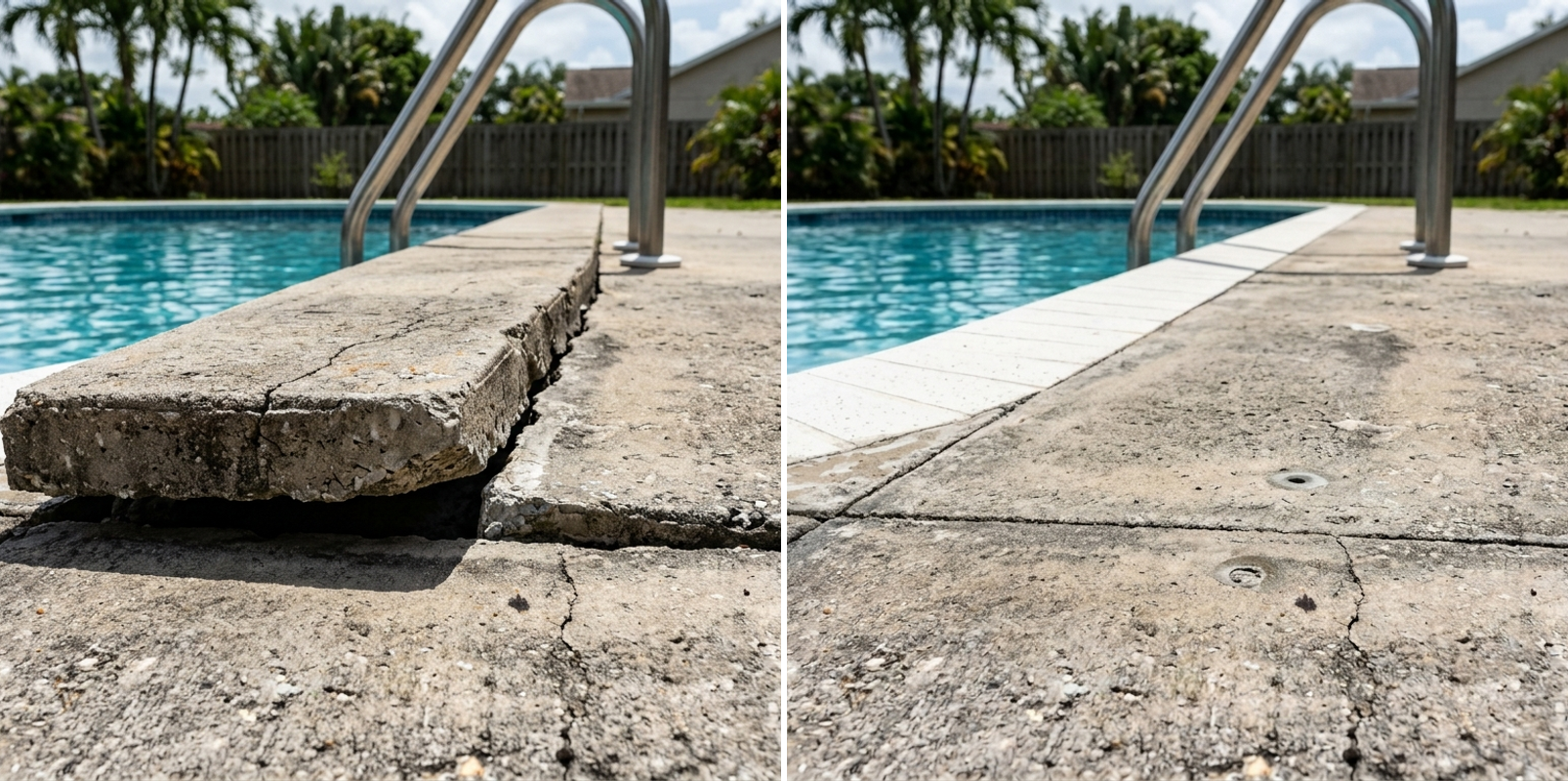
pool deck concrete raising and leveling cost Dallas TX before and after in Dallas, TX — FoamWorks Concrete Leveling Dallas
Before & After: pool deck concrete raising and leveling cost Dallas TX — AI Generated Image, may not be an accurate representation of our product or service

The unique soil composition in North Texas plays a major role in why concrete slabs sink and settle over time. The region features expansive clay soils that swell significantly when saturated with heavy rain and shrink dramatically during hot, dry summer months. This constant cycle of expansion and contraction creates voids beneath concrete slabs. When the soil underneath your pool deck washes away or compacts, the heavy concrete sinks into the empty space, leaving you with uneven surfaces, cracked coping, and tilting slabs.

When looking for solutions, property owners often compare outdated methods like mudjacking with advanced techniques. To understand how modern materials stack up against older methods, you can read more about Polyurethane Foam vs Mudjacking to see why high-density polyurethane foam has become the preferred choice for residential and commercial concrete lifting.

Understanding Polyurethane Foam Pool Deck Leveling Costs

Polyurethane foam injection—often explored through resources like Poly foam concrete raising & concrete leveling—offers a fast, clean, and permanent solution for settling concrete. But how exactly is the price calculated for a pool deck project?

Most professional contractors price slab lifting, void filling, and leveling based on the square footage and the amount of material required to lift the slab back to its original grade. General price ranges for residential projects often see standard minimum service pricing starting around $1,250, while typical patio and walkway sections range from $1,250 to $1,500. For larger areas or heavily settled driveways, prices might scale up, such as driveway projects ranging from $1,800 to $2,400 (or $800 to $2,500 depending on scope).

Compared to the high labor, disposal, and material costs of complete concrete replacement, foam injection typically costs up to 70% to 80% less. Furthermore, the entire process takes only a couple of hours, and the foam cures completely within 15 minutes of injection, meaning your pool deck is ready for foot traffic almost immediately.

Factors That Influence Your Pool Deck Repair Estimate

Every pool deck is unique, and several key variables will influence the final cost of your concrete raising project:

  • Extent of the Settlement: Decks that have dropped several inches require more polyurethane foam material and precision lifting stages to restore safely.
  • Square Footage and Layout: Larger pool surrounds or intricate shapes involving multiple expansion joints require more injection ports and careful oversight.
  • Sub-base Void Severity: If soil washout has created massive underground cavities beneath the pool deck, extra foam is needed to stabilize the sub-grade properly before the concrete can be successfully lifted.
  • Accessibility: Easy access for the specialized rig makes the process faster, whereas tight backyard gates or obstacles can require extra hose length and setup time.

While pool decks are a primary focus for summer safety, homeowners often experience settlement in other areas of their property as well. For example, if you notice issues near your vehicle parking zones, you can learn more about Driveway Concrete Leveling & Raising to see how the exact same high-density foam technology applies to heavy-load residential surfaces.

The Polyurethane Foam Injection Process Explained

Understanding what you are paying for can provide immense peace of mind. The polyurethane foam injection process is clean, non-invasive, and remarkably efficient:

  1. Strategic Drilling: The technician drills tiny, penny-sized holes (typically 5/8 inch) through the sunken concrete pool deck slab.
  2. Injection Port Placement: Specialized injection ports are fitted into the holes to deliver the high-density polymer beneath the slab.
  3. Expansion and Lifting: A custom-formulated structural polyurethane foam is injected as a liquid. It expands rapidly, filling all underlying voids, compacting the loose sub-soil, and gently raising the concrete slab back to its precise, level position.
  4. Patching and Cleanup: Once the slab is leveled, the injection holes are patched with a concrete compound that blends seamlessly with your existing deck, leaving virtually no trace of the repair work.

Frequently Asked Questions About Pool Deck Leveling

How long does polyurethane foam pool deck leveling last?

Polyurethane foam never degrades, washes out, or shrinks over time. Once the material is injected and cured, it provides a permanent, stable sub-base for your concrete pool deck, meaning the repair will last for the lifetime of the concrete.

Will the injection process damage my pool or coping?

No. Professional technicians use lightweight equipment and controlled expansion pressure to lift the concrete gradually. The process is safe for surrounding pool structures, tiles, and coping stones.

How soon can I use my pool deck after the repair?

The polyurethane foam cures to 90% strength within just 15 minutes of injection. You can walk on the repaired pool deck almost immediately after the technicians pack the drill holes and clean up the work area.

Is foam leveling messy like traditional mudjacking?

Not at all. Mudjacking pumps heavy slurry mud through large holes, creating a messy workspace. Polyurethane foam injection uses tiny holes, requires no heavy slurry, and leaves your yard and pool area impeccably clean.

Restore Your Pool Deck with FoamWorks Concrete Leveling Dallas

If you are tired of looking at a sunken, uneven pool deck or worrying about tripping hazards around your backyard oasis, do not wait for the damage to worsen. FoamWorks Concrete Leveling Dallas provides expert polyurethane foam injection, concrete raising, and concrete leveling services throughout Dallas, TX, Garland, TX, Fort Worth, TX, Royse City, TX, Ennis, TX, and surrounding communities. Save up to 80% compared to messy replacement and restore your pool deck in just hours. Contact FoamWorks Concrete Leveling Dallas today to schedule your professional assessment and get a precise quote for your property!
polyurethane foam injection vs mudjacking dallas fort worth - poly foam injection vs mud jacking dallas fort worth - foam injection vs mudjacking dallas fort worth

How Concrete Leveling and Mudjacking Restore Sunken Sidewalks in Dallas, TX

When you walk around your property in Dallas, TX, noticing a sudden trip hazard on your walkway or sidewalk can be deeply frustrating. Sunken concrete not only ruins your home’s curb appeal, but it also creates dangerous liability issues for family members, guests, and postal carriers. Property owners frequently search for reliable ways to fix uneven walks, leading them to investigate traditional mudjacking as well as advanced modern alternatives. Understanding how these repair methods restore structural integrity is vital for maintaining safe, beautiful outdoor spaces across Dallas, TX and neighboring communities like Garland, TX, Fort Worth, TX, Royse City, TX, and Ennis, TX.

Subsurface soil shifts, moisture fluctuations, and heavy rains common to North Texas frequently wash away supportive dirt underneath exterior slabs. As the sub-base erodes, sidewalks, steps, and paths sink unevenly into the earth. When faced with this issue, many homeowners look into Polyurethane Foam vs Mudjacking to determine which technique offers the most durable, long-lasting fix for their sunken concrete slabs without breaking the bank.

The Core Problem: Why Sidewalks and Walkways Sink

The clay-heavy soils found throughout Dallas, TX and Fort Worth, TX are notorious for shrinking during hot, dry summer months and expanding aggressively after heavy rainstorms. This constant cycle of contraction and expansion places immense pressure on concrete walkways. Over time, water seeps through expansion joints or hairline cracks, washing away the compacted sub-grade and creating underground voids.

When a void forms underneath a sidewalk panel, the heavy concrete weight has no support. The slab cracks, dips, or completely drops on one side. While homeowners often worry that a sunken sidewalk means a messy, expensive full-scale replacement project, modern repair solutions make it possible to lift and stabilize existing concrete in a matter of hours. In fact, many property owners also need assistance with other outdoor areas, such as Driveway Concrete Leveling & Raising, where similar soil washout issues frequently occur.

Understanding Traditional Mudjacking vs. Polyurethane Foam Injection

Historically, property owners relied exclusively on traditional mudjacking to pump a heavy slurry mixture of mud, sand, and cement beneath sunken slabs. While this method successfully raised concrete, it came with significant drawbacks. The heavy slurry added substantial weight to already unstable soil, often leading to secondary settlement over time. Furthermore, traditional mudjacking required large drill holes, disruptive equipment, and lengthy curing times.

Today, advanced techniques utilize high-density expanding polymers. To learn more about how industry materials stack up, review this guide on Poly foam concrete raising & concrete leveling. Polyurethane foam injection has completely transformed concrete lifting by offering a lightweight, waterproof, and extremely precise solution. Instead of heavy mud, a high-density structural foam is injected through penny-sized holes. The material expands rapidly, filling all underlying voids, compacting the surrounding soil, and gently raising the concrete back to its original grade.

The Step-by-Step Polyurethane Foam Injection Process

Choosing polyurethane foam injection over traditional methods provides homeowners in Garland, TX and Dallas, TX with a swift, clean, and highly effective restoration process. Here is what you can expect when professionals arrive to fix a sunken walkway:

  • Precision Assessment: Technicians inspect the sunken sidewalk, evaluating the depth of the drop, drainage patterns, and underlying soil conditions.
  • Strategic Hole Drilling: Small, penny-sized holes (typically 5/8 inch) are carefully drilled through the sunken concrete sidewalk panels.
  • Injection Application: Specialized delivery equipment pumps custom-formulated expanding polymer beneath the slab.
  • Expansion and Lifting: The two-part liquid polymer expands exponentially within seconds, safely lifting the concrete to its precise alignment.
  • –Clean-Up and Sealing: The injection ports are patched with high-grade concrete mortar, leaving the surface smooth, clean, and ready for immediate foot traffic.

Why Modern Foam Injection Outperforms Older Methods

Property owners throughout Fort Worth, TX and Royse City, TX often wonder why polyurethane foam has largely replaced older repair techniques. The advantages are clear and numerous:

First, polyurethane foam is remarkably lightweight. Unlike mud slurry, which can weigh over 100 pounds per cubic foot, structural foam typically weighs only about 2 to 4 pounds per cubic foot. This means it adds virtually zero weight to compromised sub-grades, preventing the soil compaction and secondary sinking associated with traditional mudjacking.

Second, polyurethane foam is completely moisture-resistant. Once cured, it will not wash out, degrade, or absorb water from surrounding wet clay soils. This creates a permanent, waterproof sub-base that locks out future erosion. Additionally, the material expands with pinpoint accuracy, allowing technicians to control the lift down to 1/16 of an inch.

Finally, downtime is virtually non-existent. While traditional concrete replacement can take days to cure—leaving your walkways blocked off and unusable—foam injection cures fully within 15 minutes of application. You can walk, run, or roll strollers across your restored sidewalk the very same day the work is completed.

Addressing Commercial and Residential Slabs in Ennis, TX and Beyond

Sunken concrete is not limited to residential sidewalks and front walkways. Commercial properties, multi-family complexes, and municipal parks in Ennis, TX and surrounding regions frequently deal with shifting concrete slabs as well. Uneven pavement in high-traffic commercial zones creates severe slip-and-fall hazards, exposing business owners to costly liability claims.

FoamWorks Concrete Leveling Dallas specializes in lifting and leveling all types of concrete on grade, including warehouse floors, loading docks, patios, pool decks, and driveways. By choosing targeted polyurethane foam lifting instead of tearing out and pouring new concrete, property owners can save up to 80% on total project costs while avoiding weeks of disruptive demolition noise, dust, and landscape damage.

Preventing Future Concrete Settlement

Once your sidewalks and concrete surfaces have been expertly leveled and stabilized, taking a few proactive steps can help protect your investment for years to come. Proper water management is essential. Ensure that your roof downspouts direct rainwater at least several feet away from your foundation and walkways. Keep expansion joints and minor cracks sealed with a flexible, high-quality exterior caulk to prevent surface water from penetrating the sub-base and washing away the compacted soil.

If you notice any new pooling of water or subtle settling near your walkways, addressing the issue early with professional foam injection can stop minor shifting from turning into a major structural headache.

Restore Your Concrete Today with FoamWorks Concrete Leveling Dallas

If uneven walkways, sunken sidewalks, or sagging driveways are creating safety hazards and detracting from the beauty of your property, you do not have to live with the risk. FoamWorks Concrete Leveling Dallas delivers fast, affordable, and permanent concrete lifting solutions tailored to the unique soil conditions of North Texas. Serving homeowners and businesses across Dallas, Fort Worth, Garland, Royse City, Ennis, and surrounding areas, our expert team is ready to revitalize your sunken slabs for a fraction of the cost of replacement. Contact FoamWorks Concrete Leveling Dallas today to schedule your consultation and get your concrete back on solid ground!